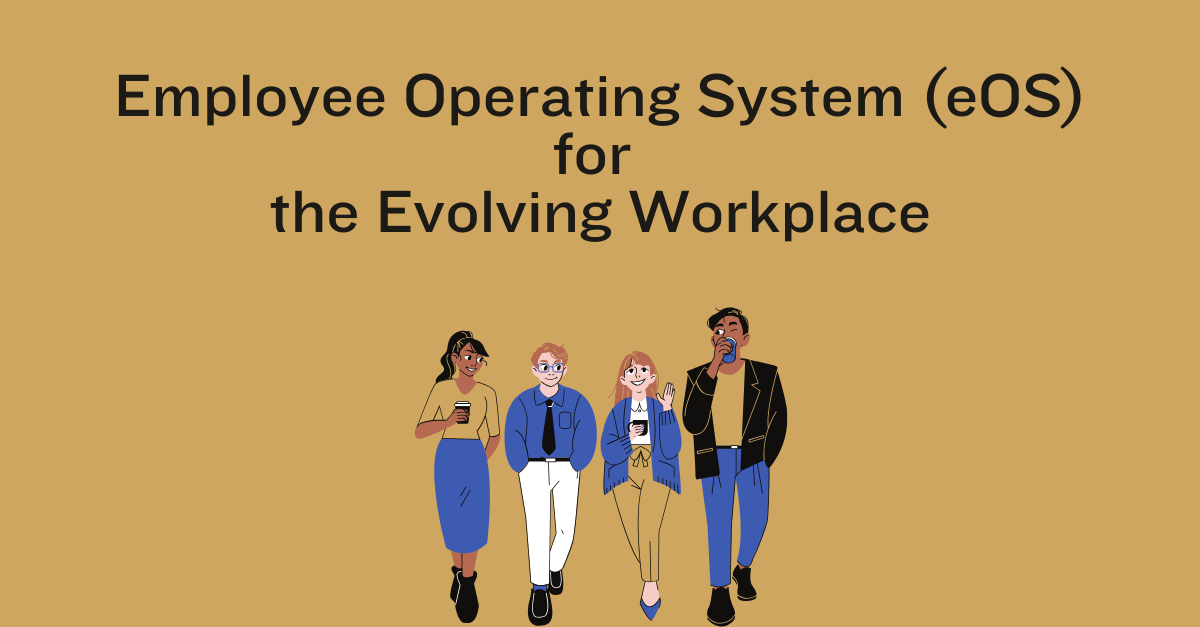
Employee Operating System (eOS) for the Evolving Workplace
Jan 22, 2026




The world of work has changed faster than most of us were prepared for.
Today’s evolving workplace is a blend of remote meetings, Slack threads, shifting priorities, AI tools, wellness initiatives, and sudden reorgs announced over video calls. Work and life bleed into each other, job security feels temporary, and mental health is part of the corporate vocabulary in a way it never used to be.
Just like Windows, macOS, Android, or Apple’s iOS all rely on core components and modules to function, your Employee Operating System (eOS) is made up of key components or elements that help you operate effectively in the ever evolving workplace.
In the middle of all this, one truth remains non‑negotiable: you are responsible for protecting your own well‑being, career, and options.
This guide is a practical set of ground rules to help you navigate the modern workplace without losing your peace, your identity, or your future prospects. It’s not about cynicism; it’s about clarity. The goal is to help you do meaningful work, grow your career, and still have a life that exists outside a laptop screen.


Created by @resumas on Canva
eOS Component #1: Your Job Is an Agreement, Not Your Entire Self
Companies often talk about “family,” “mission,” and “purpose.” Those can be inspiring — but they can also blur the simple reality that work is a professional arrangement, not your entire identity.
You are exchanging your skills, effort, and time for pay, benefits, and experience. That exchange can be fulfilling, but it should never define your worth as a person.
When you forget this:
Criticism feels like a personal attack instead of feedback.
Layoffs feel like abandonment instead of business decisions.
A tough project becomes proof you’re “not good enough” instead of a challenge to solve.
Anchor yourself in the bigger picture: you are more than a job title, more than a performance rating, and more than this season of work.
eOS Component # 2: Decode the Unwritten Rules
Every organization has two layers of rules: what’s printed in the handbook, and what actually happens day to day.
The modern workplace might promote flexibility and openness, but beneath that are real norms about:
Response time expectations on email and chat
Whether cameras “should” be on during virtual meetings
Who really shapes decisions versus who just signs off
What “work–life balance” truly means in practice
Success depends on how quickly you decode these unwritten norms. Watch carefully:
Who gets recognition—and what did they do?
What behavior gets quietly rewarded or punished?
Do people really disconnect after hours, or just say they do?
You don’t have to abandon your values to navigate this. You simply need to understand the environment you’re operating in so you can make conscious choices instead of accidental missteps.
eOS Component #3: Boundaries Are a Professional Tool
With remote work, hybrid setups, and always‑on apps, work can easily become a 24/7 background process in your life. If you don’t actively set limits, your default schedule will quietly turn into “all the time.”
Healthy boundaries are not attitude problems; they’re part of being a sustainable high performer. They look like:
Defining when you’re online and when you’re not—and mostly sticking to it
Avoiding reflexive replies to late‑night pings if it’s not truly urgent
Protecting your non‑work time as deliberately as you protect your calendar at work
Boundaries don’t mean you care less. They mean you care enough about your work to show up with energy and focus, instead of resentment and exhaustion.
eOS Component #4: Learn to Say “No” Before You Break
In many modern teams, the people who are competent and reliable become the default catch‑all. Every new task “just lands” on them because “you’re so good at this.”
If you never push back, you become the unofficial dumping ground for other people’s work. That’s the shortest path to burnout.
Learn to say no — or “not right now” — in a professional way:
“My bandwidth is full this week. Let’s discuss what I should pause if this becomes a priority.”
“I can’t lead this, but I’m happy to review the plan or give feedback.”
“That sounds important. What timeline and resources are available?”
Every time you agree to something, you’re also silently declining something else: sleep, health, family, or your own projects. Guard your capacity with intention.
eOS Component #5: Put It in Writing — Your Notes Are Your Safety Net
In fast‑moving organizations, priorities change quickly and memories get fuzzy. People are juggling dozens of threads at once. Six months later, nobody remembers who suggested what, who approved what, or why a certain decision was made.
Your best protection and clarity tool is documentation:
Follow up meetings with short recap messages: “Here’s what we agreed today…”
Save key decisions and rationale in shared documents.
Track major milestones, dates, and outcomes.
This isn’t about being paranoid; it’s about being precise. When expectations are misaligned, written records turn confusion and blame into facts and next steps.
eOS Component #6: Stop Pretending Politics Don’t Exist
Many professionals say, “I just want to do my work and stay out of politics.” It sounds noble but often translates to, “I don’t understand how power and decisions actually work here.”
“Office politics” is simply the network of relationships, trust, influence, and reputation inside a company. You can engage with it ethically — or you can let it shape your career without your input.
Playing this game with integrity means:
Building genuine relationships, not just strategic ones
Understanding who influences budgets, promotions, and project approvals
Staying aware of tensions and alliances without feeding gossip
Being known as someone who is fair, respectful, and dependable
You don’t have to scheme. But you do need to be conscious of the human system around you.
eOS Component #7: Keep Your Manager in Perspective
Modern cultures often flatten hierarchies and encourage informality. That can make relationships with managers feel friendly — even personal.
But your manager is ultimately still your evaluator, not your therapist or your best friend. In good times they can be a strong supporter; in tough times, they still have obligations to the company that may conflict with your preferences.
A healthy dynamic looks like:
Transparency about your goals, challenges, and workload
Respect for their boundaries and pressures as well
Realistic expectations about what they can and cannot influence
Parallel relationships with other leaders and peers so your entire career doesn’t hinge on a single person
Great managers can change your life. But no manager should become the sole pillar holding up your sense of security.
eOS Component #8: Show Your Impact Without Overshadowing
“Doing great work quietly” is romanticized — but in a distributed, noisy, modern workplace, it often means going unnoticed.
You need to communicate your impact without grandstanding or stepping on toes. That means:
Regularly sharing concise status updates focused on outcomes, not just activity
Highlighting team wins and explicitly acknowledging others’ contributions
Connecting your work to real metrics: revenue, savings, risk reduction, user satisfaction, or efficiency
Making your manager look informed and successful when they present your work upward
You’re not trying to compete with your boss. You’re aiming to be recognized as someone who reliably delivers value and lifts the whole team.
eOS Component #9: Refuse the Gossip Trap and Respect Everyone
The backchannel will always exist: side chats, DMs, quiet complaints after meetings. Joining in can feel bonding in the moment — but it’s rarely worth the long‑term cost.
Gossip doesn’t just hurt the subject; it damages the trust others have in you. If you speak negatively about colleagues behind their backs, people assume you’ll do the same to them.
Protect your reputation by:
Avoiding character attacks in any format that can be copied or forwarded
Taking serious concerns to the right channels (HR, your manager, or formal feedback) instead of rumor mills
Treating everyone—from executives to interns and cleaners—with the same baseline respect
In a connected world, your behavior travels faster than your job title. Choose how you want to be known.
eOS Component #10: Network Like Change Is Guaranteed
In the modern workplace, jobs end for reasons that have nothing to do with your performance: market shifts, funding cuts, mergers, strategy pivots.
Waiting until you’re unemployed to “start networking” is like waiting until you’re thirsty to dig a well.
Make relationship‑building part of your normal work rhythm:
Stay connected with former coworkers and managers
Participate in professional communities, online and offline
Share ideas, lessons, or small wins publicly when appropriate
Help others by making introductions, reviewing resumes, or offering perspective
When you do this consistently, you’re never starting from zero when you need a new opportunity — you’re activating a network you’ve already invested in.
eOS Component #11: Create a Financial Escape Hatch
One of the harshest realities of the modern workplace is that many people stay in harmful environments because they simply can’t afford to leave.
You can’t control every factor, but you can steadily build financial breathing room:
Aim for an emergency fund that covers a few months of essential expenses
Increase savings gradually when your income grows, instead of inflating your lifestyle at the same rate
Avoid tying your entire financial life to bonuses or stock that may be volatile
An emergency fund isn’t just about surprise expenses — it’s about having the option to walk away from a job that’s damaging your health without going into crisis mode.
eOS Component #12: Question the Default, Don’t Sleepwalk
Doing things “the way we’ve always done them” is especially risky in a world defined by rapid change. Technology, customer expectations, and best practices evolve quickly; blind compliance doesn’t make you safe, it makes you obsolete.
Bring thoughtful curiosity to your work:
Ask why processes exist before repeating them
Suggest improvements with respect and evidence, not just complaints
Stay informed about trends in your field, especially around automation and AI
Look for ways to simplify, streamline, or upgrade how your team operates
You don’t have to be a rebel to add value. You just have to keep your brain turned on.
eOS Component #13: Treat Time as Your Most Limited Asset
Endless meetings, redundant check‑ins, and chaotic calendars can quietly steal years of your life. In remote and hybrid setups, it’s easy to confuse “being in meetings” with “doing meaningful work.”
Respect for time starts with you:
Show up on time—it signals reliability and respect
Decline or question meetings that lack a clear purpose or agenda
Protect focused work blocks on your calendar for deep, undistracted efforts
Suggest alternative formats (async updates, recorded demos, shared docs) when live meetings aren’t necessary
You can’t control every invite, but you can be intentional about how much of your finite attention you give away.
eOS Component #14: Put Mental Health on the Critical Path
Workplaces now talk more openly about mental health, but cultural change is still uneven. Many people are quietly overwhelmed while trying to appear “fine.”
Your mind is the engine behind everything you do at work. If that engine is running hot all the time, something will eventually break.
Treat mental well‑being as a core part of your professional toolkit:
Notice patterns of dread, exhaustion, or numbness—not just occasional bad days
Use support that’s available: employee assistance programs, counseling, coaching, support groups
Build non‑work routines that refill your tank: sleep, exercise, hobbies, creativity, connection
Have honest, solution‑oriented conversations with your manager when workload or pace becomes unsustainable
You’re not a machine; even machines need maintenance. Long careers are marathons, not sprints.
eOS Component #15: Speak Up for Your Growth and Compensation
In a complex, fast‑moving environment, leaders rarely have perfect visibility into every individual’s contributions. If you wait quietly for someone to “notice” you deserve more, you may be waiting a very long time.
Advocating for yourself is not arrogance; it’s part of owning your career:
Keep a personal record of your achievements, outcomes, and positive feedback
Connect your work to clear business results when you discuss it
Be explicit in performance conversations about what you’re aiming for: a raise, a promotion, a different scope, more flexibility
Prepare for those conversations with data and examples—not just feelings
The modern workplace is not a perfectly fair system. You increase your odds of fair treatment by being prepared, confident, and clear.
eOS Component #16: Keep Learning Beyond the Company Playbook
Many corporate learning programs focus on compliance and immediate job requirements. That’s the bare minimum — not the roadmap for a resilient career.
Skills now have shorter shelf lives. To stay relevant, you need to invest in yourself beyond what your employer mandates:
Identify durable skills that travel with you: communication, leadership, problem‑solving, data literacy, tech fluency
Explore courses, books, podcasts, and workshops that stretch you
Apply new skills through side projects, cross‑team collaborations, or volunteer work
Stay curious about how your role and industry are evolving, especially under the influence of new tools and automation
When you move on from a company, you leave the systems and perks behind — but you take your skills and growth with you. That’s your true long‑term asset.
Summary
The evolving workplace isn’t getting simpler. Hybrid schedules, rapid change, economic uncertainty, and mental‑health pressure are here to stay. But within that complexity, you still have meaningful control.
You can choose to:
Treat work as one part of a rich life, not the center of your existence
Learn the real rules of your environment without losing yourself
Protect your time, attention, and energy with firm but fair boundaries
Say no before you’re overwhelmed, not after
Document agreements so you’re anchored in facts, not shifting memories
Acknowledge office dynamics instead of pretending they don’t exist
Maintain perspective on your manager’s role in your life
Make your impact visible in a way that builds trust and respect
Build and maintain a network that gives you options
Create financial space to leave harmful situations
Think critically instead of coasting on autopilot
Put your mental health on equal footing with your performance
Keep learning so that change expands your opportunities instead of shrinking them
You won’t control market cycles or corporate decisions. But you can build a employee operating system (eOS) that keeps you grounded, employable, and mentally steady no matter what happens around you.
In a world where companies can pivot overnight, the real goal is simple: design a life, a mindset, and a skill set so strong that no single job can define you — or destroy you.
Exploring your next job options ?
Check out resumas.com for essential job seeker tools. Our platform includes a free AI resume builder, resume tailoring or customization options, recommendations for industry associations and certifications, LinkedIn profile optimization, pre-generated cover letters and follow-up emails, and a management dashboard to track applications. In today’s competitive job market, it’s important to have smart strategies to streamline your search.
Visit resumas.com now!
References
1. https://www.springhealth.com/blog/rooted-2025-chro-the-future-of-work-and-mental-health
2. https://www.mindsharepartners.org/2025-mental-health-at-work-report
3. https://eyeofthesquid.com/competing-to-be-unique-in-your-career-4abed0a51426
5. https://blog.startupstash.com/career-planning-both-boring-and-impossible-13ddc9e61d64
6. https://blog.venturemagazine.net/keep-your-job-with-those-engineering-best-practices-36b410eb46e3
8. https://technology.justworks.com/should-i-transition-from-engineer-to-manager-be42d577badd




 SignUp